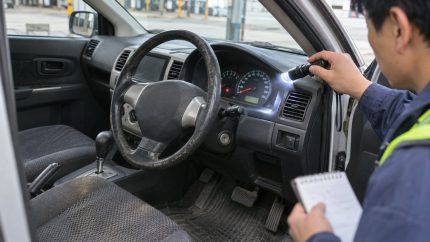
Your customs broker asks for the car’s first registration date, chassis number and weight. You have a Japanese export certificate, an English translation and a commercial invoice. Which entry should you use, and how do you know that all three documents describe the same vehicle? This guide shows where to look and how to check the file before it reaches customs.
Key takeaways
- Start with the manufacturer’s serial number, commonly called the chassis or frame number, and match it character for character across the certificate, translation, invoice and shipping document.
- Read the first registration date as a Japanese registration record. Do not present it as the production date unless separate evidence establishes when the vehicle was manufactured.
- Sumotori provides an export certificate translation service. Tell us the destination and your broker’s document requirements before the translation is prepared.
What is a Japanese car export certificate?
A Japanese export certificate is produced through the vehicle deregistration or planned-export process in Japan. It records the identity and Japanese registration details of the vehicle that is being exported. The document supports the export file, while the commercial invoice records the sale and the bill of lading or sea waybill records the shipment.
Japan Customs explains that a registered vehicle must go through registration deletion before export. A vehicle that was deregistered earlier follows a planned-export notification process. The related certificates described by Japan Customs are valid for six months from issue. The exact document route is handled in Japan, and the destination broker should confirm what must be presented locally. Japan Customs procedure for exporting used vehicles.
The Osaka Chamber of Commerce and Industry publishes a Japanese bilingual sample form and a separate English sample translation. The layout can vary, so identify the field by its label and value rather than relying only on its position on the page.
The six checks to make before you send the document
| Check | Where to look | What to compare |
|---|---|---|
| 1. Vehicle identity | Manufacturer’s serial number | Invoice, auction record and bill of lading or sea waybill |
| 2. Registration history | First Registration Date and Last Registration Date | The date requested by your broker or registration agent |
| 3. Vehicle specification | Manufacturer, model and engine model | Auction sheet, inspection record and invoice |
| 4. Capacity and body | Shape, seating capacity and carrying capacity | The import category and local approval file |
| 5. Technical figures | Engine capacity, fuel, dimensions and weights | Inspection, freight and destination declarations |
| 6. Timing and reference | Certificate reference and scheduled exporting date | The exporter’s document record and the certificate validity |
Check the fields in that order. A mismatch in the vehicle identity stops the file from being reliable. A difference in weight, body type or registration date may change how the vehicle is classified at destination, so refer it to the local broker before clearance documents are finalised.
Read the certificate field by field
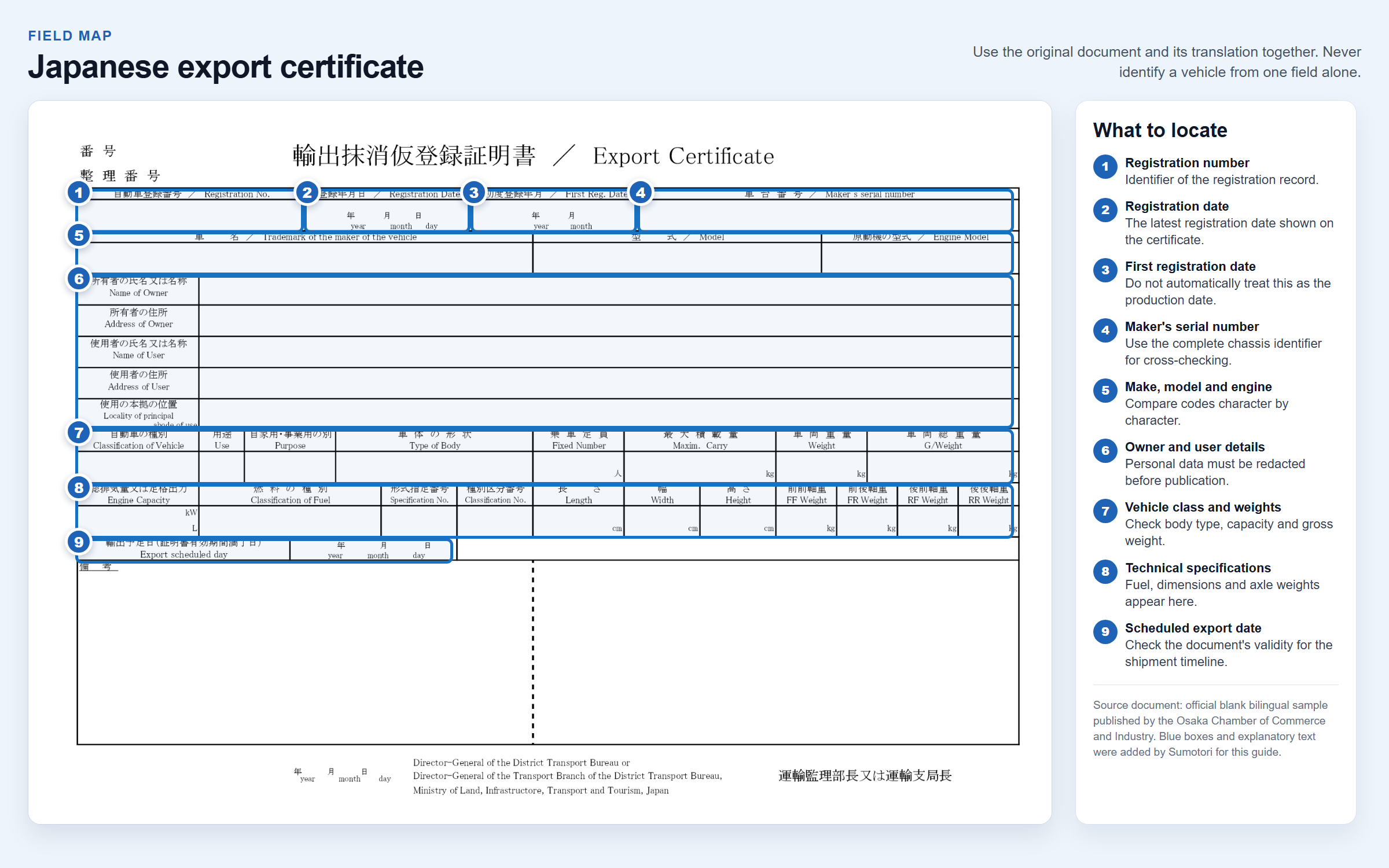
Use the numbered groups as an orientation map, then read the actual entries and any remarks on the original certificate. Layout and annotations can vary, so identify the vehicle from the complete chassis number and reconcile the document with the invoice and shipping record.
1. Match the chassis number first
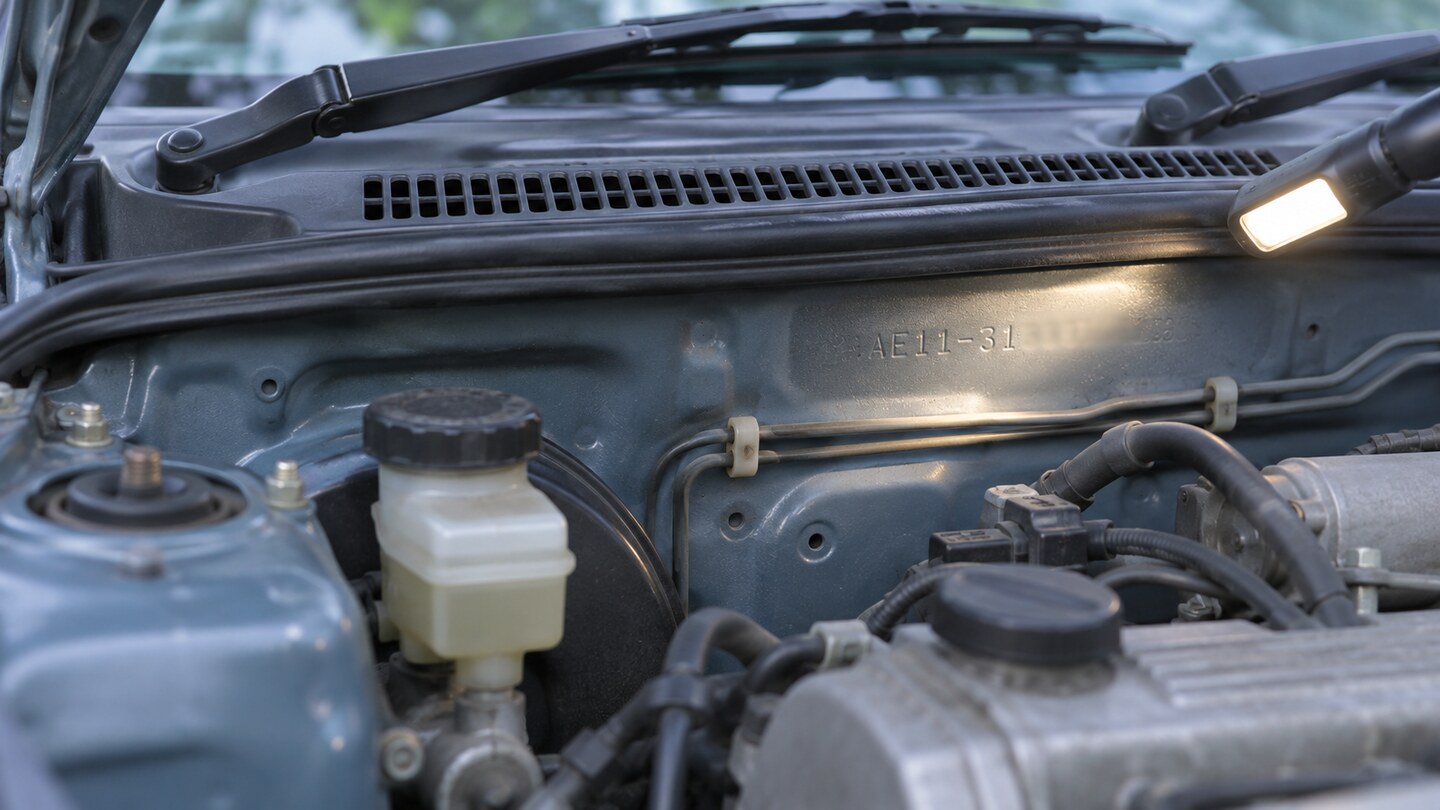
The official English sample calls this field Manufacturer’s serial number. In export work it is commonly described as the chassis number or frame number. Some Japanese domestic-market vehicles use a manufacturer-format identifier rather than a 17-character VIN. Copy the spacing and punctuation only when they are part of the recorded identifier, and check every letter and digit.
Compare the number with the commercial invoice, purchase record and draft shipping document. Ask for a reference photograph of the identifier on the vehicle when your destination file or internal controls require it. A photograph helps establish which car was inspected, while the official documents remain the records used in the transaction.
2. Separate first registration from manufacture
The certificate distinguishes the First Registration Date from the Last Registration Date. The first is the year and month when the vehicle was first registered in Japan. It does not, by itself, state the factory production date or model year.
This distinction matters when a destination applies eligibility, tax or registration rules by manufacture, model year, first registration or age on arrival. Give your broker the exact label and date shown. If production month is required, obtain separate manufacturer or model-specific evidence instead of renaming the registration date.
3. Read the model and engine fields together
The certificate includes the manufacturer, model number and engine model. These fields help distinguish vehicles that share a sales name but have different bodies, engines or regulatory specifications. Compare them with the auction record and inspection file before using a tariff, compliance route or freight estimate intended for another variant.
A customer may know the car as a Toyota Prius or Nissan Serena. The model code and engine model narrow the identification to a particular technical configuration. Preserve those codes in the translation exactly as recorded.
4. Check body, seating and carrying capacity
Classification of vehicle, purpose of use, shape of vehicle, seating capacity and carrying capacity describe how the vehicle was registered in Japan. These fields can matter when the destination distinguishes a passenger car from a van, bus, pickup or cargo vehicle.
Use the values as source data for the broker. The destination authority applies its own categories. If a vehicle has been modified after its Japanese registration record was issued, send current photographs and inspection evidence as well.
5. Check engine, fuel, dimensions and weights
The form can record engine capacity or rated output, fuel, length, width, height, vehicle weight, maximum gross weight and axle weights. These figures support identification, shipping planning and local declarations. Keep the units shown on the source document and make any conversion separately so the original value remains traceable.
Do not assume every field must contain a value for every vehicle. Where a required destination field is blank or unclear, ask Sumotori to check the Japanese record and ask the broker what alternative evidence is accepted.
6. Record the certificate reference and timing
Keep the certificate reference with the vehicle file and use it when discussing a correction or replacement. Check the issue or scheduled-export information shown on the document. Japan Customs states that the registration-deletion and planned-export certificates in its procedure are valid for six months from issue, so an older file should be reviewed before shipment. Japanese customs guidance.
Use Sumotori’s export certificate translation service
Sumotori can prepare a translation after the Japanese export certificate becomes available. Send us the destination country, the language required and any instructions from your customs broker or registration agent. This lets the translation preserve the vehicle codes and present the relevant fields in a form your receiving team can follow.
- Send the broker’s requirements before the document package is finalised.
- Sumotori checks the Japanese certificate and prepares the requested translation.
- Review the chassis number, dates, model codes, weights and names against the Japanese original.
- Send the original and translation together with the other documents required for the destination.
Ask the local broker whether the translation needs certification, notarisation, a particular template or an original signature. Those requirements belong to the destination procedure. A translation makes the source record readable. It does not change the Japanese entry or resolve a discrepancy between documents.
Compare the certificate with the rest of the vehicle file
| Document | What it establishes | Fields to cross-check |
|---|---|---|
| Auction sheet or inspection record | The lot identity and recorded condition before purchase | Lot, model code, chassis number and vehicle specification |
| Commercial invoice | The sale between the named parties | Seller, buyer, chassis number, price, currency and sale terms |
| Japanese export certificate and translation | The vehicle’s Japanese registration and export record | Chassis number, registration dates, model, engine, body and weights |
| Bill of lading or sea waybill | The carriage of the vehicle | Consignee, chassis number, loading port and destination port |
The four records serve different purposes. A clean file lets a broker follow one vehicle from the auction record to the sale, Japanese export record and shipment. If the chassis number differs, stop the handover and have the issuing party correct the affected document. If a name or port differs, confirm whether the document is still a draft before requesting the amendment.
A five-minute handover checklist
- The Japanese original and translation belong to the same certificate reference.
- The complete chassis number matches the car, invoice and shipping document.
- First registration is described as first registration.
- Model, engine, body and capacity agree with the vehicle ordered.
- Measurements retain the source units and any converted values are labelled.
- The buyer, consignee and their roles are clear in the full document package.
- The broker has confirmed the required format and any certification of the translation.
For the sequence from auction purchase through deregistration, documents and shipping, use our guide to what happens after winning a Japanese car auction. Sumotori’s dealer team can coordinate the Japan-side vehicle purchase, export documents and shipping file. Discuss dealer sourcing and document support.
Frequently asked questions
Is the first registration date the manufacture date?
No. It records when the vehicle was first registered in Japan. Obtain separate evidence if the destination requires the manufacture date or production month.
Does every Japanese car have a 17-character VIN?
No. Some Japanese domestic-market vehicles are identified by a manufacturer-format chassis or frame number. Match the complete identifier used in the Japanese documents.
Can Sumotori translate the export certificate?
Yes. Sumotori provides an export certificate translation service after the Japanese certificate is available. Send the destination and the receiving broker’s format or certification requirements before preparation.
Do I need the original export certificate and a translation?
Requirements vary by destination and procedure. Ask the customs broker or registration agent whether it needs the original, a copy, a translation and any certification.
How long is the Japanese certificate valid?
Japan Customs states that the registration-deletion and planned-export certificates described in its used-vehicle export procedure are valid for six months from issue. Confirm the date and shipment plan for the specific vehicle.
This guide explains the fields in the published Japanese and English sample forms and Sumotori’s document workflow. Destination authorities decide which documents, translations and certifications they accept. Confirm the requirements for the specific vehicle with your customs broker or registration agent.