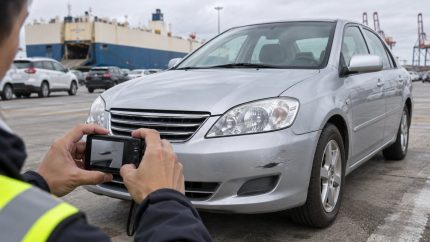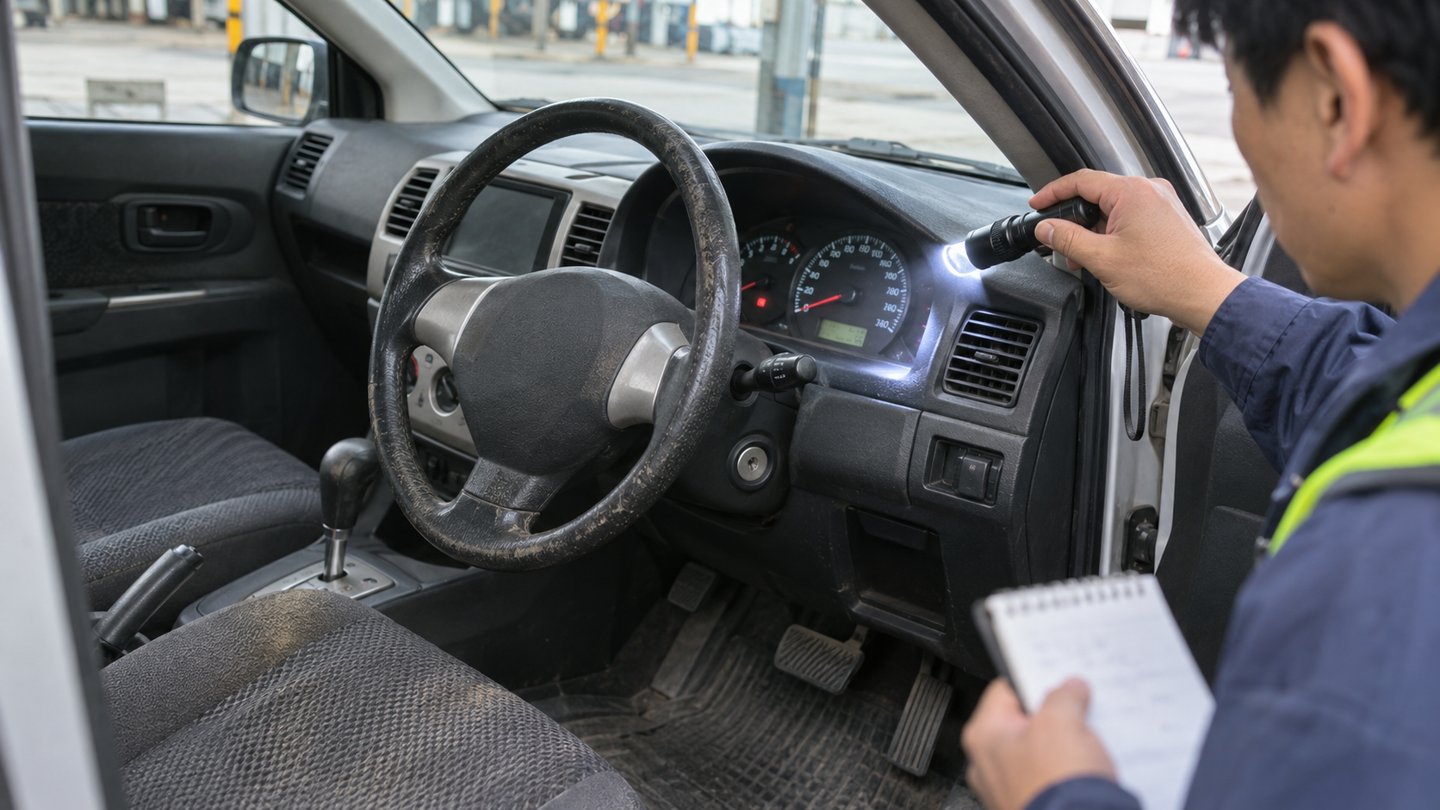
Odometer checks for Japanese cars going to New Zealand should establish whether the displayed distance agrees with the available history. Build a dated record for the exact car before buying, investigate conflicting readings and keep the evidence for your receiving and sales teams.
A photograph of the dashboard answers one question: what number was displayed when the photograph was taken? Your dealership also needs to understand what that number represents and whether any replacement or uncertainty has been recorded.
Key takeaways
- Put dated readings in chronological order and keep their source documents.
- Treat a lower later reading as a discrepancy to investigate, without assuming its cause.
- Resolve import eligibility separately from the wording used when advertising a car in New Zealand.
Why the mileage question matters before shipment
New Zealand Customs guidance states that vehicles without an odometer, or with an odometer that incorrectly records the distance travelled, can only be imported with consent from the Minister of Customs. This is an import restriction, not simply a question of how to price the car.
The Customs Import Prohibition (Motor Vehicles) Order 2021 sets out the prohibition and consent provision. If a vehicle’s history raises an unresolved accuracy issue, take the records to your New Zealand broker and Customs before committing to shipment. Do not assume that disclosing the issue in a future sales advertisement resolves the import requirement.
Guidance checked on 20 November 2026. This article concerns cars intended for ordinary dealer stock; unusual vehicles and special-purpose imports need their own assessment.
Build a mileage timeline for the individual car
Start with the full chassis number. Link every record to that identifier before comparing the numbers. Similar model names, repeated auction lot numbers or photos without a vehicle reference can make unrelated records look like one history.
Create a short timeline using the records available. Keep the date, reading, unit, document type and any qualification together. Retain the Japanese source alongside the translation so an inspector can examine the entry in context.
| Record | What to capture | Limit of the evidence |
|---|---|---|
| Current odometer photograph | Reading, kilometre or mile display, date and vehicle reference | Shows the current display, not the entire driving history |
| Auction record | Sale date, reading and the complete mileage notes | Must be read with any uncertainty or replacement notation |
| Service or inspection record | Dated reading and matching vehicle identity | Provides a historical point; gaps may remain |
| Japanese export record | Any recorded mileage information and its associated dates | Read the actual entries; do not assume every record provides a complete history |
| Odometer verification report | Inspector, date, chassis number, findings and stated scope | Use the conclusion actually issued, including limitations |
A missing service book does not by itself prove tampering. Equally, a sequence that rises steadily does not establish every kilometre the car has travelled. The aim is to identify what the evidence supports and where it leaves a material question.
The AA describes its own odometer inspection process as reviewing available service records and vehicle history, then checking whether wear is consistent with the stated reading. This illustrates why the dashboard number is only part of the assessment. AA odometer inspection guidance.
Work through a discrepancy before deciding to buy
Example 1: the later reading is lower
Consider this fictional file for one car: a dated service record shows 82,400 km, a later auction record shows 91,200 km and the current listing shows 63,100 km. All three records appear to carry the same chassis number.
That sequence needs an explanation. First check the source images, dates, units and copied digits. Then ask for any instrument-cluster replacement record and the full auction remarks. A typing error, a mismatched record and a changed odometer require different evidence; the number alone does not establish which occurred.
Keep the car out of your approved buying list while that question remains open. If the source information confirms an inaccurate odometer, refer the actual circumstances for a New Zealand import assessment. A lower bid does not resolve eligibility.
Example 2: the instrument cluster was replaced
In another fictional file, the car has a workshop record of a cluster replacement. Request the replacement date, the old reading, the replacement unit’s starting reading and the vehicle identity on the record. Check what the current display now measures.
For arithmetic illustration only, suppose the old unit recorded 70,000 km, the replacement started at zero and now displays 18,000 km. Adding those figures gives 88,000 km. That calculation depends on the assumptions being correct. It is not an official correction, a verification certificate or permission to import.
Send the original records to the inspection provider and New Zealand broker. Have them identify what can be established and whether the import restriction requires further action. Preserve the evidence and conclusion instead of silently replacing the displayed reading with your own total.
Arrange a check that answers the unresolved question
A useful inspection request describes the conflict. For example: “Please compare the attached service and auction readings with the current odometer and investigate the recorded cluster replacement.” This gives the provider something specific to assess.
Before commissioning the work, establish the following:
- Which Japanese history sources and physical checks the provider can use.
- Whether the car can be accessed before the auction or only after purchase.
- What report you will receive and whether it identifies the exact vehicle.
- How the report describes an unresolved history, replacement or suspected discrepancy.
- When the findings will be available relative to your bid and shipping decisions.
If the necessary report will arrive only after purchase, that timing belongs in the buying decision. Do not describe a car as mileage-verified while the check is still pending. If the provider cannot reach a conclusion, keep that result visible in the file.
The wider pre-bid inspection guide covers other condition checks. For this mileage review, use it to arrange access and reporting; keep the odometer findings as a distinct part of the vehicle record.
Carry the evidence through to the New Zealand sales file
Save the source documents, translations, current reading photograph and any inspection conclusion under the chassis number. Include the status of unresolved questions and who is handling them. Your receiving team should be able to follow the file without reconstructing discussions from messages.
After arrival, record the displayed reading again with its date. If it differs from the expected sequence, compare the original files and refer the discrepancy for investigation before using it in sales material.
For retail sales, the Commerce Commission’s used-vehicle guidance requires an accurate and complete Consumer Information Notice for covered vehicles, including its display in online advertisements. The guidance distinguishes consumer sales from trader-to-trader transactions.
The Commission also tells dealers to describe vehicle history accurately and have reasonable grounds for their claims. Avoid advertising “verified mileage” merely because a previous listing used those words. Keep the supporting report for any verification claim your business makes. Commerce Commission guidance for dealers.
A practical final review asks: does the file explain the displayed reading, have conflicts been resolved, has import eligibility been addressed, and can the sales team support the description it intends to use? Record the answer to each question separately.
For Japan-side sourcing and export coordination, see Sumotori’s Japan-to-New Zealand service page. Send mileage concerns while shortlisting so the available evidence and inspection timing can be considered before bidding.
This guide provides general information. Its mileage examples are fictional and do not establish a vehicle’s actual distance or import eligibility. Confirm odometer evidence with an appropriate inspection provider and resolve New Zealand import or disclosure questions with Customs, your broker or a qualified local adviser. This article does not constitute a public offer.