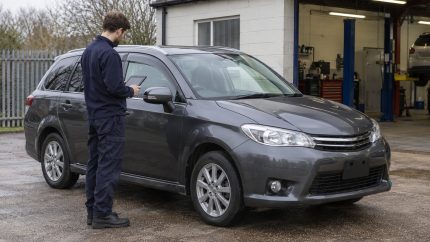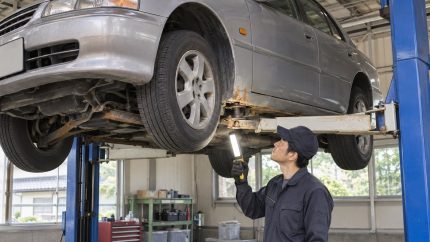
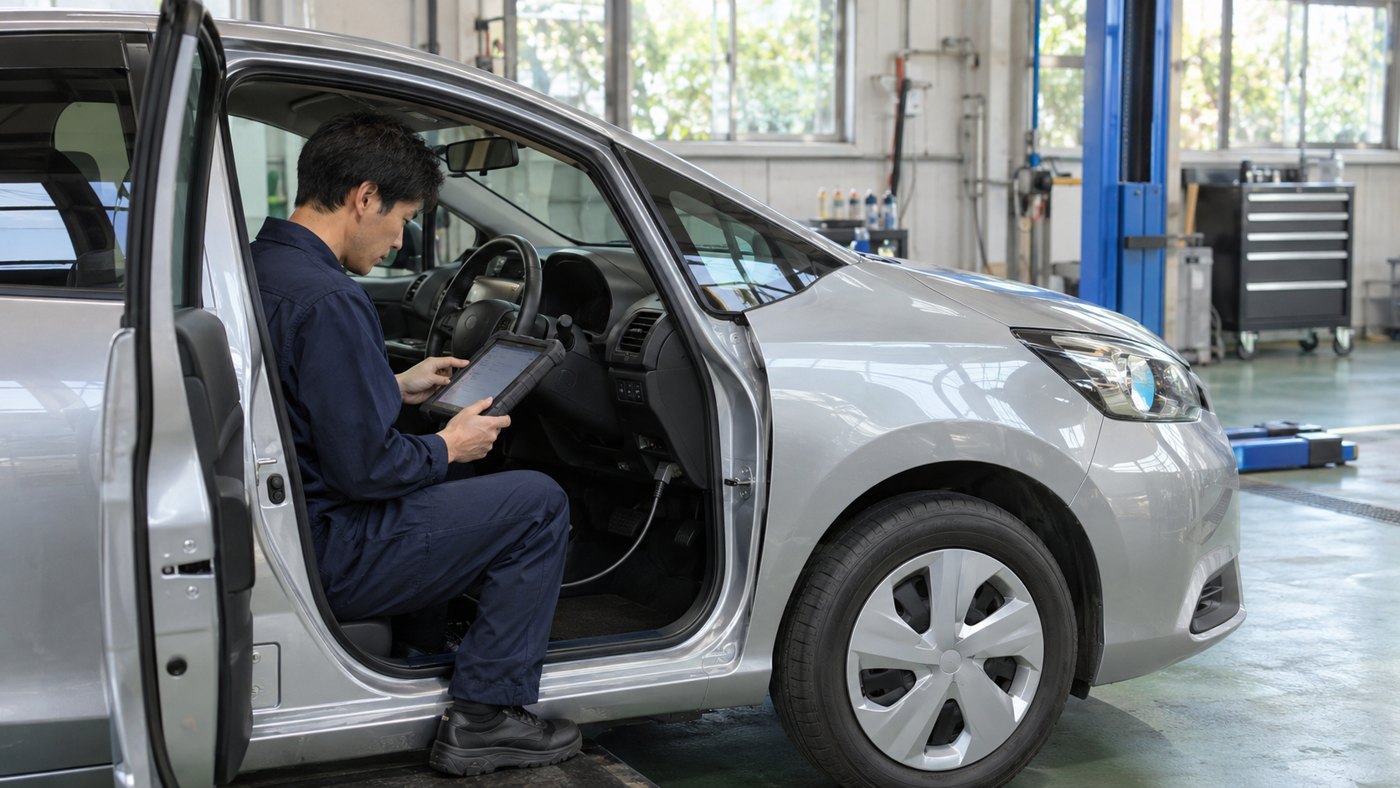
Hybrid battery checks should tell a dealer what was tested, on which car, and what remains unresolved. A photograph of a charged battery display is not enough to assess its condition. Before buying a used hybrid in Japan, request a vehicle-specific inspection report and use its findings to decide whether to proceed, price repairs or pass on the car.
Key takeaways
- Identify the traction battery, the 12-volt battery and the exact test behind each result.
- Read the inspection scope and conditions before comparing health percentages or a simple “pass.”
- Use unresolved findings to set a repair allowance or stop the purchase; do not promise a battery lifespan from one report.
Start by identifying which battery was checked
A hybrid has a traction battery used by the drive system and a separate auxiliary battery. A report about the auxiliary battery should not be filed as evidence that the traction battery is healthy. Ask the inspector to name the component tested rather than writing only “battery OK.”
Record the full chassis or VIN, model code, powertrain and odometer reading. Check that these agree with the auction listing or stock offer. Also record the test date. A clear report for another vehicle, or a report issued before a later repair, does not answer the current buying question.
If a replacement battery is advertised, request the invoice, installation date and identification of the fitted part. Find out whether the claim concerns a complete assembly or work on individual components. Do not turn a general description such as “battery serviced” into a claim that the whole unit was replaced.
Separate state of charge from battery health
State of charge describes how much charge is available at the time. For example, Toyota’s battery-management information describes charge level and remaining range for supported electric and plug-in hybrid vehicles. These are operating displays, not a universal measurement of remaining battery life.
State of health is an assessment of battery condition relative to a reference. When a report uses that term, ask what it measures and how it is calculated. A tool may provide a numerical estimate, a set of test results or a pass/fail outcome. Do not assume that different tools express the same thing.
If a seller sends a screenshot marked “80%,” establish what the number means before using it. It might describe current charge rather than health. Even a value explicitly labelled health needs the test method, reference and technician’s explanation. There is no useful comparison until those details are known.
Request hybrid battery checks with a defined scope
Toyota Cyprus lists five elements in its Hybrid Health Check: hybrid-system diagnostics, battery health, battery insulation, auxiliary-battery charging and cooling-system checks. This is a useful manufacturer example of why an inspection can involve more than a battery percentage.
It is not a promise that the same branded service, warranty or report is available for every Japanese import. Ask the workshop inspecting your car which model-specific procedures it can perform. Agree on the output you will receive and any access limits before paying for the job.
| Report item | What the buyer needs to establish |
|---|---|
| Identity and date | The report belongs to the selected car and records when it was inspected. |
| Test method and scope | Which systems were checked, with what procedure, and which checks were omitted. |
| Diagnostic findings | The recorded faults or observations and the technician’s explanation of their significance. |
| Conditions and measurements | The circumstances needed to interpret any values or comparisons reported. |
| Conclusion and next action | What passed, what needs diagnosis or repair, and whether another test is recommended. |
For reported battery-block or temperature readings, ask the technician to interpret the measurements under the manufacturer’s procedure. Avoid applying a voltage-difference limit copied from another model or an online discussion. Raw numbers without operating conditions can look precise while leaving the decision unclear.
Read cooling and warning findings in context
Toyota’s Japanese Prius manual describes a traction-battery cooling intake and filter that require attention when obstructed. This is a model-specific example: identify the relevant manual and cooling arrangement for the actual car.
If the inspector finds a dirty intake or a cooling-related warning, request the finding and the proposed follow-up. Cleaning an accessible intake may be part of the work, but it should not be presented as proof that every battery concern has been resolved. Ask for the appropriate check after the work.
Likewise, a warning message should lead to diagnosis of its cause. Record whether the report contains an active issue, an earlier stored finding or an item requiring further investigation, using the technician’s terminology. A blank warning display alone cannot document which checks were performed.
Hybrid systems contain hazardous high-voltage parts. Toyota’s Prius safety instructions prohibit removing or dismantling high-voltage components and orange wiring. Have qualified personnel perform the inspection; do not request improvised battery opening or probing for auction photographs.
Turn the report into a purchase decision
Separate a known repair from an unknown fault. For a known repair, obtain a written estimate that identifies the part, labour, any diagnostic work and the verification after repair. Check availability for the exact model with the workshop that would do the work in your market.
For an unresolved fault, do not insert an arbitrary small allowance and call the risk covered. Request further diagnosis or decline the vehicle if the uncertainty is outside your buying policy. Our general guide to pre-bid checks in Japan explains how to arrange targeted checks within the auction timetable.
Consider a fictional comparison. Car A has a dated, identifiable report with a defined scope and no unresolved findings in that scope. Car B is cheaper, but its only evidence is an “80%” screenshot with no test explanation. These cars do not yet have comparable condition evidence.
The dealer first asks for the missing information on Car B. If the follow-up identifies repair work, its confirmed cost enters the comparison. If the uncertainty remains, the dealer can pass on B instead of assuming that the saving will cover a future battery bill. This is an illustrative buying decision, not a Sumotori case.
Carry the evidence into your resale file
Keep the original report, the inspector’s explanation and any repair records with the individual vehicle. Describe the actual test and date when discussing the car with a customer. A check records findings within its scope; it should not become an unsupported guarantee of remaining years or kilometres.
Use Sumotori’s passenger-car sourcing service to discuss the selected vehicle and which checks can be arranged in Japan. Confirm the inspection scope and access separately for each order.
Manufacturer sources checked on 26 November 2026. The cited Toyota services and manuals illustrate specific procedures and terminology; use the instructions applicable to your car and destination.
This is general information for business buyers, not a public offer, diagnostic opinion or battery-life guarantee. Confirm inspection arrangements with your exporter and have a qualified hybrid-vehicle specialist interpret the findings, repair requirements and any applicable local rules.