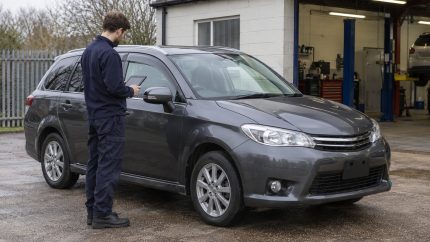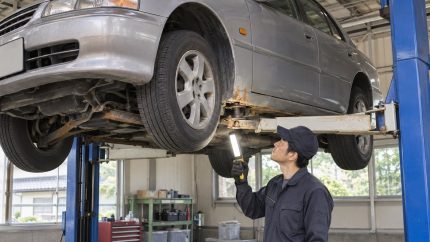

Used car tyre checks should produce a record for each wheel position, not a single comment that the tyres look good. Before buying in Japan, establish what is fitted, what condition evidence is available and what suitable replacements would cost in your market. Treat an unreadable marking or an inaccessible tyre as missing information, rather than a pass.
Key takeaways
- Record the tyre specification, date code and condition at each wheel position, including any spare.
- A recent date or deep-looking tread does not establish the complete condition of a tyre.
- Price the correct replacement specification and fitting work before using the car’s purchase price to judge the deal.
Start used car tyre checks with the vehicle specification
Get the full model or chassis code and the vehicle’s tyre placard or relevant owner’s-manual information. Compare that specification with the tyres fitted now. An aftermarket wheel or a previous owner’s replacement choice is a reason to investigate, not evidence that the specification is correct.
Michelin’s sidewall guide explains size and service markings. In an illustrative code such as 205/55 R16 91V, 205 is nominal width in millimetres, 55 is the sidewall-height ratio, R means radial construction and 16 is the wheel diameter in inches. The final number and letter describe load and speed ratings.
Record the complete marking, including any additional designation, rather than keeping only “16-inch tyres.” Have the tyre supplier check the required load and speed specification for the exact vehicle. Do not interpret the load-index number as a weight in kilograms.
Also establish whether the front and rear specifications are intended to differ. A difference is a finding to compare with the manufacturer’s instructions; it is not automatically a defect. Likewise, four matching sidewalls do not by themselves prove suitability.
Build a record that covers the whole car
Use one row per position: front left, front right, rear left and rear right, plus the spare if fitted. Ask for photographs that let the reviewer connect each marking and condition observation with the correct wheel. A collection of unlabelled close-ups is difficult to audit.
| Record field | Evidence to request | Why it matters |
|---|---|---|
| Position and specification | Labelled sidewall photograph with the complete marking. | Shows which tyre was checked and helps the supplier assess fitment. |
| Brand and product range | Readable name or a written transcription checked against the photograph. | Distinguishes tyres that share a size but are different products. |
| Manufacturing code | A clear photograph of the date marking where accessible. | Records production timing without guessing from the car’s registration. |
| Tread and visible damage | Measured readings and photographs of the area concerned. | Replaces a vague description with a finding that can be reviewed. |
| Uninspected areas | A note identifying what could not be seen or measured. | Prevents a partial inspection from being recorded as complete. |
Request tread readings across the accessible tread width and at more than one point around the tyre, where the inspection arrangements allow. Record the measured locations. An outside photograph may leave the inner edge unexamined; tell the inspector which missing view matters.
Use a safe workshop arrangement for additional access. Do not ask someone to crawl under an unsupported vehicle or remove a wheel without suitable equipment. The task is to obtain a reliable condition record through competent personnel.
Read the manufacturing code without inventing an expiry date
The US National Highway Traffic Safety Administration’s TireWise guidance explains that the final four digits of a DOT tyre identification number give the production week and year. For example, 2122 means week 21 of 2022. The full marking may require a view of the other sidewall.
If the expected code is not visible, request a better view or confirmation of the applicable marking. Do not choose an unrelated mould number as the date. The tyre’s production date is separate from the car’s first registration and from when the tyre was installed.
NHTSA also warns that ageing cannot be detected simply by looking at a tyre. Check the vehicle and tyre manufacturers’ replacement guidance and have a professional assess the actual condition. A recent date is not proof against damage, and unused tread does not erase the effects of age or storage.
Turn wear and damage into a workshop question
NHTSA identifies cuts, cracks, bulges and irregular wear among reasons to stop using a tyre or seek professional attention. If an inspector reports such a finding, ask what must happen before the vehicle can be moved or driven safely. Do not wait for the resale preparation stage to address an immediate safety concern.
Keep the observation separate from the diagnosis. “Inner shoulder worn more than the centre” records what was found. It does not, by itself, establish which suspension or alignment component caused it. Request the relevant workshop assessment and price that work separately from the replacement rubber.
For a wheel or tyre change, ask the supplier to assess the complete proposed setup against the vehicle specification. Include any manufacturer instructions about matching tyres. Avoid buying one convenient replacement solely because the wheel diameter matches.
Price a replacement plan, not an optimistic allowance
Get a quote identifying the tyre make, product, full specification and quantity. Have fitting, balancing, valves or monitoring-system work identified where applicable. Ask whether further diagnosis or alignment is included. Missing lines are unresolved costs, not zero-cost services.
Here is a fictional budgeting example, not a Sumotori tariff or market quote. Assume a workshop has specified four replacements at 120 units of your accounting currency each. Fitting and balancing total 80. The planned tyre work is 4 × 120 + 80 = 560, before any separately quoted repairs.
Suppose a cheaper car saves only 400 against another candidate, but requires that confirmed 560 of tyre work. Its apparent saving is already gone before considering other condition differences. Use the actual replacement plan to compare the cars, rather than assuming every fitted tyre can stay in service.
For questions beyond the tyres, use the pre-bid vehicle checks guide. Keep this tyre record with the wider condition report so your purchasing and preparation teams work from the same findings.
Check the spare and the destination requirements separately
Record whether the car has a spare wheel, a temporary spare, a repair kit or another arrangement. Include it in the inspection request instead of discovering the missing item after arrival. For a kit, check the contents and any stated expiry information; do not assume the original equipment is still present.
Your destination may have specific roadworthiness, seasonal or tyre-approval requirements. Have the local specialist apply the current rules to the fitted tyres and intended use. This guide does not turn one country’s tread threshold into a universal import rule.
Discuss available records and inspection access for the selected car through Sumotori’s passenger-car sourcing service. Sources checked on 27 November 2026.
This is general information for business buyers, not a public offer or a tyre-safety certificate. Confirm the vehicle’s condition and inspection scope with your exporter, and have a qualified tyre or vehicle specialist check fitment, replacement needs and the current requirements in your destination.